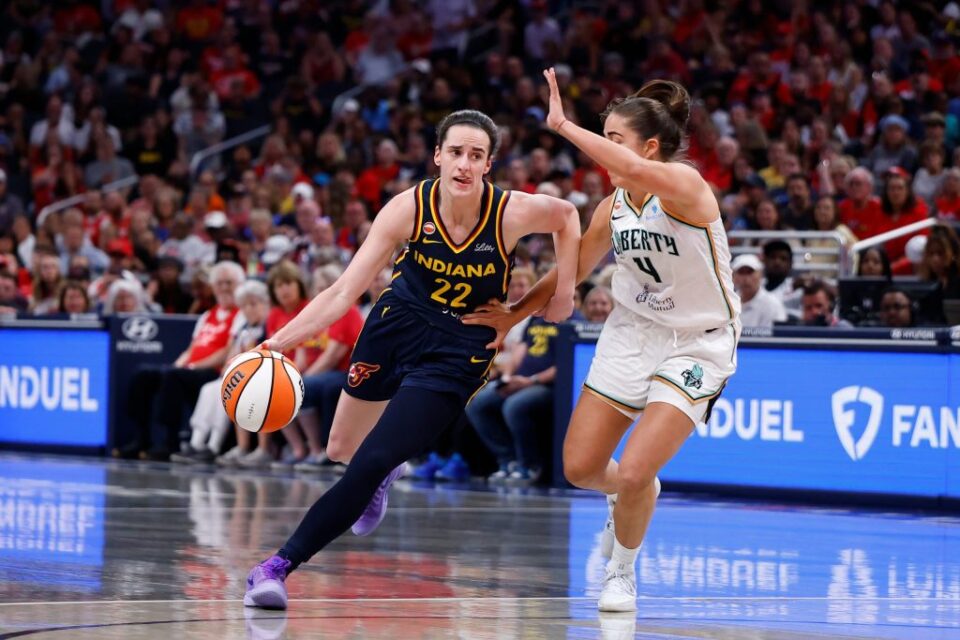

The appropriation of Caitlin Clark as a cultural weapon by those on the right of this country’s ideological spectrum is a time-worn tactic. Her elevation as a widely known sports figure both in the United States and internationally is the product of her immense skills on the basketball court — as well as her ethnicity.
There have been many electric women basketball players that preceded Clark, but none have approached her enormous stature as a prolific driver of ratings and revenue for the sport. The through line of the substantial increase in WNBA salaries, which began this past off-season with the inception of the league’s new collective bargaining agreement (CBA), is Clark’s meteoric ascendance as a star college player for the University of Iowa and to her record-breaking early WNBA career with the Indiana Fever.
Clark’s league marks include most assists ever in a WNBA game (19) and the only player to post a 40-point, 10-assist game. She achieved the latter last Friday with 45 points and 10 assists in a 110-107 win over the Seattle Storm. But her play must ultimately translate to the Fever being a championship contender. Indiana was No. 6 overall in the standings at 16-10 when they hosted the Connecticut Sun last night.
Every game the 24-year-old Clark plays has become a litmus test of white privilege and a referendum on race. On whether she is being targeted by Black players allegedly jealous of her gravitational pull on brands — Nike, Xfinity, State Farm and Gatorade among them — which combined pay her more than $16 million annually. Or on whether those same players hold grievances against the factions of the media that anointed Clark the WNBA’s preeminent personage before she had earned the accolade.
Clark’s ardent supporters have accused her opponents of being overly physical with her and even playing dirty. In late June, the Phoenix Mercury’s Alyssa Thomas was suspended by the league for one game for pushing down on Clark’s neck while Clark was lying on the court during a loose ball scramble. Thomas, a well respected 13-year WNBA veteran, insisted the act was without malicious intent and accidental. But to those who subscribe that there is widespread animosity toward Clark by her peers, it was compelling evidence.
There should be no debate that the Las Vegas Aces’ A’Ja Wilson, with her signature Nike basketball shoe, is the best women’s player in the world. The Minnesota Lynx’s Napheesa Collier, the WNBA’s MVP runner-up last season to Wilson, who was set to make her season debut last night after having surgery on both of her ankles this past winter, is another player in addition to several more ahead of Clark on the list of the league’s best players.
But Clark is a convenient tool of right-wing activists even after they nearly abandoned her after Clark liked global music star Taylor Swift’s 2024 Instagram post endorsing then-Democratic presidential nominee Kamala Harris in her race against Donald Trump. Clark later clarified her liking the post was not an implicit endorsement, but her encouraging people to register and vote for their preferred candidate.
Clark, on the surface, has appeared to be socially center-left, but knowing a core of her fanbase is center-right or even far-right, is careful not to alienate those demographics. Until she explicitly rejects their racist and repressive principles, she will be a human armament deployed in their culture war.
The post The cultural weaponization of Caitlin Clark is a tired playbook appeared first on New York Amsterdam News.
